


The National External Assessment (NVO) decides which secondary school your child goes to next.
Preparation gives your child a choice.
It is the exam after grade 7, and its score decides which secondary schools your child can apply to. With Intreea, your child walks into the exam room with confidence, not under pressure. The platform consolidates the material in maths and Bulgarian step by step, and you see the progress every day.
Two exams, 100 points each, and one door
The NVO after grade 7 consists of two exams, Bulgarian language and literature and mathematics, each with a maximum score of 100 points. The two results make up your child's admission score for the secondary school you have been discussing at home for the past two years.
That is why seventh graders talk about results in points. And preparation is what turns points into a choice.

Check your child's current level with a free mock test.
Intreea NVO mock test
This free test is the easiest way to see where your child stands today and where more work is needed.
Start the free mock testThe exam is not the hard part. The year before it is.
There is a lot of material and it moves fast. A new lesson is taught in class, and little time is left for consolidation. Regular practice with Intreea solves that.
The exam is based on what is learnt in grades 5 and 6. In both subjects the tasks bring back what was learned earlier: fractions and equations in maths, grammar and reading comprehension in Bulgarian. Solid foundations make every next step easier.
Marks and the exam measure different things. A mark reflects one lesson; the exam covers the whole year. With Intreea you see the skills section by section, not just the marks.
A clear plan instead of cramming and memorising. When you know exactly where your child gets stuck, every week has a goal and every test has a purpose.
Rhythm is the way to succeed. Preparation is a marathon, not a sprint. A little, but every day. And with Intreea your child will be coming back for more.


How to prepare your child for the NVO
It is never too early or too late to start. Six principles that help make every day a step forward.


First, find out where your child stands, then ask them to go through mock tests.
The first job is to find out which topics are problematic. Otherwise your child only revises what they are already good at, just because it is easier.
A magnifying glass over an open notebook on a mossy stone, with a lantern beside it.Good practice
- Start with a short test based on every section, not just the last lesson.
- Write down which topics are hard, with the section's name.
- Check the notes again a month later and compare.
Avoid
- Do not start with the easy topics.
- Do not judge by grades at school: they only show how much the child knows, not exactly what they know.
- Do not assume the material taught at the beginning has already been learnt.
Start by catching up on material from previous years.
If the knowledge gaps from earlier years are not closed, the new material will not be learnt. Sort out the gaps from earlier grades before the grade 7 ones, even if it is already December.
Three old books stacked one on another, with a ribbon coming out of the bottom one.Good practice
- Close the knowledge gaps before new material is taught.
- Order the topics by how they build on one another, not by the textbook.
- Mark every topic learnt, so progress is visible.
Avoid
- Do not study grade 7 material on top of earlier knowledge gaps.
- Do not skip a topic because it was covered in class.
- Do not replace understanding with memorisation.
A little every day is better than a lot at once.
A little today and tomorrow makes the material easy to take in. Three hours back to back on a Sunday leads to cramming.
A pocket watch and a small candle beside an open notebook and a cup of tea.Good practice
- A little, but more often.
- One clear goal per session: one topic, one task type.
- Stop when the time is up, even if it is going well.
Avoid
- Do not pile the missed days of studying into one long Sunday.
- Do not study late into the night before a test.
- Do not change the topic halfway through a session.
Mock exams are measurement, not preparation.
One mock every few weeks is useful. One every week brings pressure, not progress.
A small pair of scales with a scroll in one pan and a ruler in front of it.Good practice
- Do one mock test every three to four weeks. Make it timed and unassisted.
- Do the mock test under exam conditions: in a quiet room with a clock nearby to monitor time.
- Compare with the previous mock, not with classmates.
Avoid
- Do not run a mock every week.
- Do not rely on the mock as preparation.
- Do not announce the score to your child as a verdict.
Look at the mistakes, not the points.
The score says how much. The mistake says why. A mock test that is not reviewed is time lost.
A parchment with a crossed-out line, a quill, an inkwell and a magnifying glass on it.Good practice
- Go through every mistake together with your child and name it: carelessness, a knowledge gap, or a misunderstanding.
- Work on the problematic tasks again a few days later.
- Keep a list of the kinds of mistakes that are repeated.
Avoid
- Do not look only at the overall result.
- Do not leave a mock test unreviewed.
- Do not fix the mistake for your child.
This is a marathon, not a sprint.
A pace that can be kept for nine months beats a pace that stops in February.
A lantern turned right down on a windowsill, with a blanket and a cup beside it.Good practice
- Plan a pace you can keep up with for nine months, not nine weeks.
- Let at least one day a week be a rest day.
- Mark the progress, not only what is left.
Avoid
- Do not sign up for a new tutoring school in February out of panic.
- Do not compare with other children.
- Do not take away rest time as a punishment for a weak mock test result.
Our NVO courses
Built to the Bulgarian Ministry of Education curriculum. Try them completely free for 14 days.
Bulgarian language and literature, grade 7
Two courses, Bulgarian language and Literature, including NVO exam preparation.
€12,96 a monththe first 14 days are free


In Intreea, your child has their own place in the Tree of Knowledge.
The avatar, the little house and the rewards earned along the way grow with everything your child learns. That is why they are eager to come back to this magical world, day after day until June.
The Guardians of knowledge
![]()

![]()
Siana
Perseverance
Suggests you try once more.
![]()

![]()
Nikola
Belonging
Asks how you feel.
![]()

![]()
Mira
Questions
Asks what we can learn.
![]()

![]()
Stefan
Understanding
Helps you understand the mistake better.
![]()

![]()
Luca
Exploration
Makes everyone laugh, even when something goes wrong.
![]()

![]()
Anna
Wonder
Reminds everyone that a single mistake doesn't define you.


What it looks like on the inside
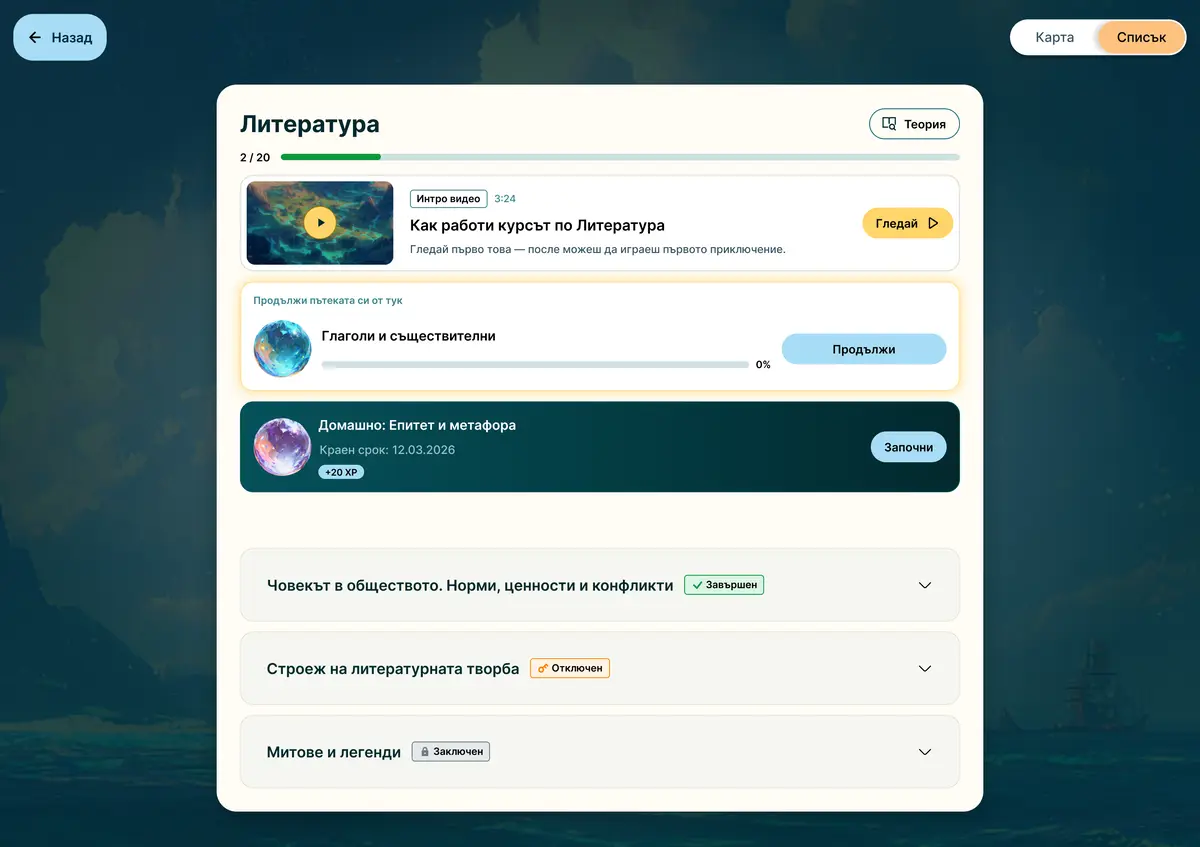
Children can always tell where to continue from
Each section unlocks once the previous one is complete. Points, streaks and rewards move your child along a single path, and homework comes with a deadline. All your child sees is the next step.
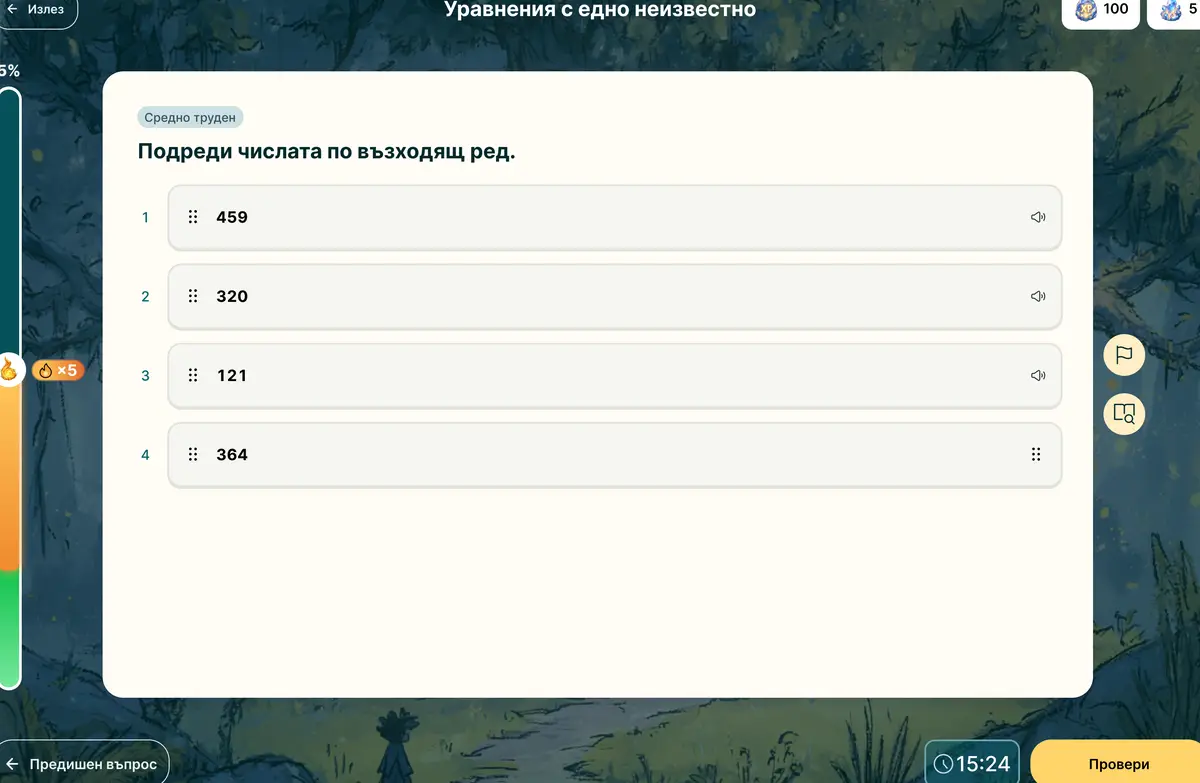
A variety of task types
The material is practised through different kinds of tasks, so your child really comprehends it instead of memorising it.
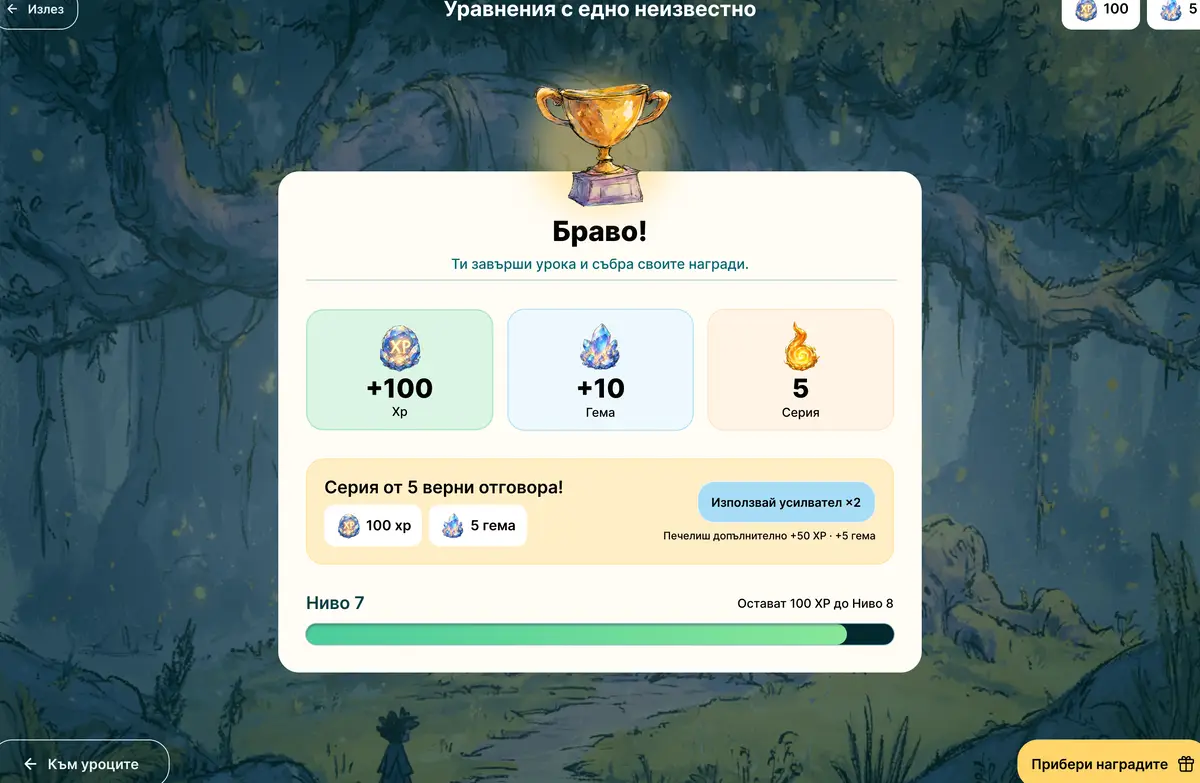
Success is visible right away
Points are awarded for every correct answer, with streaks and rewards at the end of the lesson. Progress is shown on the very same day.
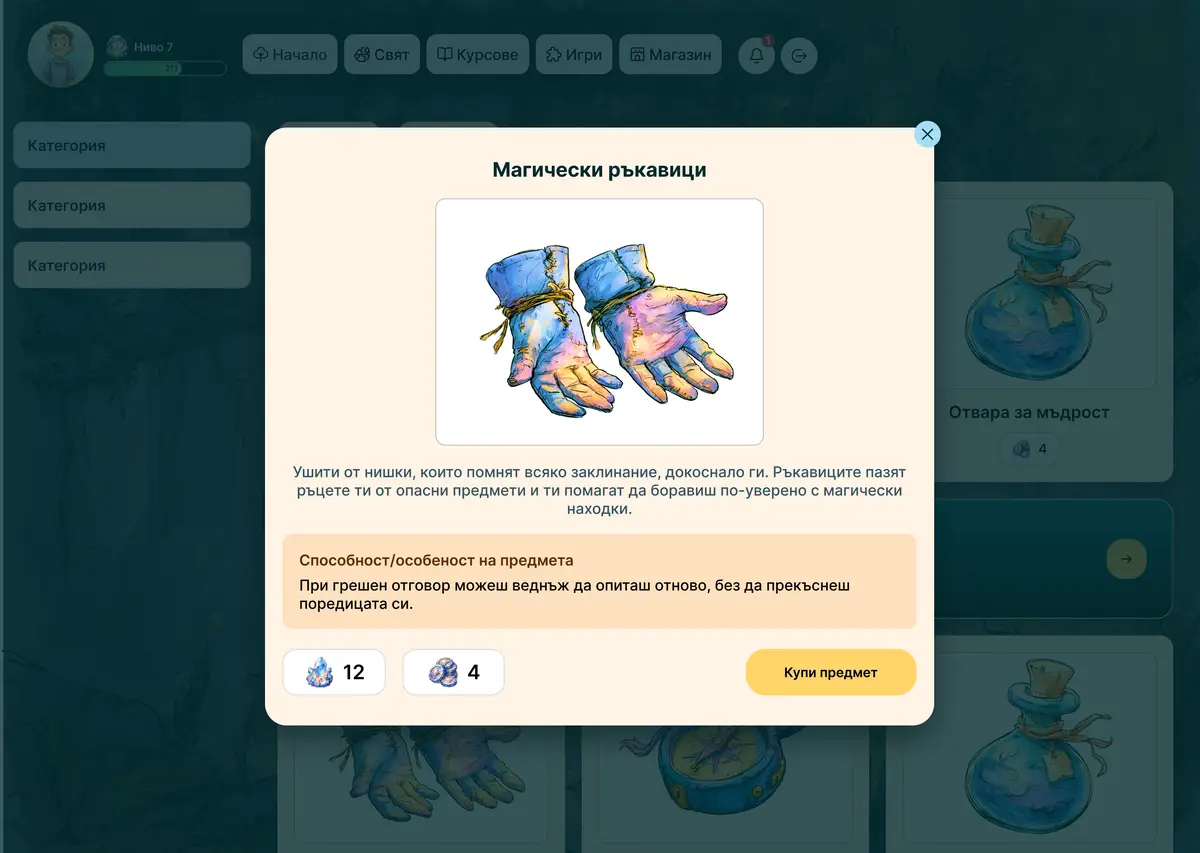
Artefacts with a part to play in the lesson
What is earned is spent on magical artefacts that change something in the learning process: for example, a second try after a wrong answer without breaking the streak. Every artefact has a role in learning.


Questions about the NVO and Intreea
Does it cover the whole NVO?
Yes. Maths and Bulgarian language and literature for grade 7, both following the Bulgarian Ministry of Education curriculum, with preparation for the exam.
How do I find out where my child should start?
Through the free mock exam on this page. Then, in the app, every exercise solved refines the starting point and sets the next lessons. The first 14 days are free.
Is Intreea enough on its own, or do we need additional tutoring too?
It depends on your child's starting point and the time left until June. Use the 14-day free trial to work together: if the explanations are clear and your child sees where they go wrong, Intreea is a sound foundation. In the parent profile you can monitor progress section by section and make a judgment call based on it.
From which grade does it make sense to start?
The course follows the 7th grade curriculum, but it starts where your child needs to begin from, including the topics from grades 5 and 6 that need consolidating. It is never too early or too late to start.
I do not want additional screen time.
We understand. Our lessons are short, with clear goals guiding your child through the tasks to a clear end. Screen time is limited and meaningful.
What exactly does the parent see?
Parents can see progress section by section, monitoring exactly what children cover successfully or struggle with. Knowledge gaps are visible in specific lesson sections.
Can Intreea be used at school too?
Yes. Teachers choose the lessons and the number of tasks, and every pupil gets a different task version. For more information, see the For schools page.

Spot the difficulties before they turn into real knowledge gaps.
The free mock exam shows where your child should start. No pressure, and a clear vision until June.
- 92%Would recommend Intreea to another parentOngoing NPS survey in the app.
- 86%Find the platform easy to useUser interviews and tests, around 100 participants.